.comment-link {margin-left:.6em;}

Chronicles from a Caribbean Cubicle

5/10/2008

Outlook 2007

This has nothing to do with the Caribbean, but I have to add my own words of frustration regarding Outlook 2007.

It is SLOOOOOOOOOW.

I am shocked that some development team in Microsoft let it out of the lab and into production.

The only thing it offers of value that I have found is a prettier interface, and a few slightly better options.

Other than that, I am amazed that I upgraded from Outlook XP to Outlook 2007, skipping 1 upgrade, only to arrive here ... with a much slower program that bogs down my entire computer when it's running. I actually cannot afford to run it all the time due to the time it wastes.

Unbelievable.

Labels:


Read more!

2/20/2008

Recession and Productivity

Talk of a recession in the U.S. is now fully underway.

In the Caribbean, we have just begun to talk about the fact that when a recession hits the U.S., the after-effects are felt here. As if the increase in oil prices were not enough, we can also expect to see a drop in tourist visits and a decrease in average tourist spending. This affects our bottom-line in Jamaica and other countries in the region that are dependent on the tourist industry as the biggest earner of foreign exchange.

If a recession is to come to the region, then we can expect to see redundancies as companies cut their payrolls to keep their costs in line with a reduction in business.

It's a good time for employees to start to think about a strategy to make themselves invaluable to their employers. An employee would do well to find ways to do more with less, as the chances are good that their managers are going to be turning to them to ask them to do just that.

If a redundancy is announced, it's likely that the least productive employees are the ones that are at the greatest risk. In turn, the most productive ones will be assuming the workload of those that are laid off.

While most managers won't give their employees anything new to deal with the extra load, the smart ones will start now to give them tools, training and alternatives that help them get the job done.

For example, elance, the outsourcing service, offers an excellent value for money, and now would be a good time to get used to using the service. Also, Framework's NewHabits-NewGoals productivity programme would be an alternative for professionals looking to boost their ability to deal with more each day.

It also might be a good time to buy that extra memory for the laptop, or to set up work-at-home arrangements wherever possible -- all in favour of boosting productivity.

The current estimates say that a recession won't be felt here in the region until 9-12 months from now, so there is still ample time to prepare.

Labels: , ,


Read more!

8/18/2007

Building an Environment that is Open for Business

Now that we are ten days away from election day, I am remembering an article (http://urlcut.com/dchuck) that Delroy Chuck wrote about creating an environment in Jamaica that is business-friendly.

Beyond the politics of what he has to say, there is a truthful point. I recently opened a business here in Jamaica, and I finally received the legal papers in August 2007 after waiting from December, 2006.

In an earlier post entitled "The Thwarting of the Creative Class", I shared some research that showed that Jamaica's ranking among countries in terms of how easy it is to do business is terribly low, even after years of efforts to make things easier.

Labels: ,


Read more!

7/29/2007

When Everything Becomes a Business

It is unfortunate that in today's world that everything has "become a business".

Test Cricket -- "nothing more than a business"
Professional Football -- "a money-making venture"
Fine Art -- "basically a form of entrepreneurism"
etc.

While it is accurate that these and other pastimes can be seen as businesses, I think it is a mistake to argue forcefully that they can all be reduced to mere financial concerns.

It is true that they all have commercial aspects, but untrue that they should be seen through this lens exclusively. Everyone suffers when this happens, and when it happens too often a certain cynicism creeps into even the most altruistic activities, such as volunteerism and donations.

It is almost as if there is an accusation that if a cricketer is not viewing, for example, his career as a business, then he is not being realistic, or not being professional.

This might have a grain of truth, but it is also true that a test cricketer is not a mercenary. To think of what they do as "just a job" is to reduce the activity of playing cricket at the highest level to the most empty kind of employment.

The greater truth is that business-leaders are desperately trying to move their companies away from being entities whose only relationship to their people is one of trade -- my money for your time and effort.

Instead, companies are at their best when people are able to lay aside such interpretations and are able to approach their jobs as if they are volunteers, with the kind of fervor and commitment that enhances their experience of being human, and deepens their working relationship with their co-workers.

It is tragic when a young professional allows the "commercial trade" that is a necessary part of their relationship with their employer to override all over concerns, even the concern for their own frame of mind.

Labels:


Read more!

4/01/2007

Individual Brilliance, Collective Stupidity


I just got up from in front of the television, where the West Indies is, once gain, disappointing this cricket fan.

At the moment the score reads 48/3 against Sri Lanka, and it looks like we are in for our third beating in a row.

So, I thought I would take a break... Lara's recent soft dismissal was the icing on the cake. Onto other more uplifting topics...

Yesterday's Boys and Girls High School Champs was yet another triumph, not just for the winners (Calabar) but for the Jamaican sporting fraternity. Last year, I wrote about my experience at Champs, and why attending it was so absolutely inspiring.

Not coincidentally, Patrick Robinson's new book: "Jamaican Athletics: A Model for the World" was also launched, describing how the structure and spirit of our homegrown athletic system that has produced more currently top rated athletes that any other country in the world apart from the United States. At the heart of our system is our Boys and Girls Champs -- the greatest athletic competition in track and field in the world for high school students.

What impresses me, however, is that Champs stands out as an exception to what I would describe as a general Caribbean weakness in our ability to work together in groups. (Trinidad's Carnival is also another exception.)

In my work in corporations I have noticed the same phenomena: very sharp people who are unable to work together.

In politics the same: very smart politicians who are rendered impotent by each other, effectively nullifying whatever interest they have in serving the people of Jamaica.

In communities our very high murder rate here in Jamaica is driven by disputes large and small between individuals, gangs, neighborhoods, schools and sports teams.

What is it about us Jamaicans that make working together productively so very difficult?

In a prior blog I mentioned the idea that the pursuit of self-interest is a good thing, if it is allowed to blossom and grow into a realization that your best interests are also mine, but turns into something dangerous when we either pretend that we have no self-interest, or we stop, and fail to take our pursuit past the point of a narrow selfishness.

Often, we are our own worst enemies.

Recently at the corner of Ardenne and Hope Roads thieves stole the controller to the traffic light, rendering it useless.

I can imagine the same thieves riding on the bus later that week, complaining that the government has done nothing to fix the lights... without any sense of irony.

Yet, this is often what we do. We create our own problems, at first for each other, and then for ourselves.

We are undoubtedly a smart set of people, but that kind of brilliance we show is probably not as important as the kind that we need -- if there is a thing called "group intelligence" then that is what we need to order up as quickly as possible.

It is only now that I am back living in Jamaica that I can say that there is a kind of group intelligence that I observed in US companies that I don't see here to the same degree -- this in total hindsight.

From my recollection of working abroad:
  • In discussions, I often observed people make a deliberate decision to step back in order to allow a consensus to form.
  • In meetings, I remember participants willingly surrendering their positions, in order to allow the group to move forward.
  • When dealing with companies as a customer, a customer service agent would make amends in order to keep me as a customer.
  • At stoplights, drivers would yield the right of way.
  • Upon being introduced, people would start by finding common ground.
These might all be taken to be the marks of polite company, but I think there is more to it than that. After all, Americans are not altogether a polite people, in the sense that the British are.

They are a very practical people, however.

Perhaps one aspect of group intelligence is knowing when to yield, in order to maintain a certain cohesiveness.

If so, then it is a skill we are sadly lacking here in Jamaica.

Instead, our particular determination to succeed comes from our commitment to justice and on protecting our " rights."

These are powerful, potent points of focus -- they have motivated the "creation"/revelation of a religion such as rastafarianism, the rise of a leader such as Marcus Garvey and the fame of Bob Marley, among others.

They also lead to protest, murder and mayhem, with our irrational sensitivity to being "dissed."

However, they are not enough, as our economic failures have demonstrated.

The recent lawless activities taking place in our schools has had some commentators talking about our "insistence on having things our way." When we all engage in actions designed to get what we want, others be damned, we doom ourselves, because in a small country such as ours what goes around, surely comes back around. The movie "Crash" comes to mind.

It seems that we need to develop an ability to think about the welfare of the group, in addition to our own, and to act accordingly.

However, Boys and Girls Champs are a clear exception to the rule, rising from a 6 school event with 70 athletes (all male) in 1910 to one in 2007 that that has 63 schools and 2200 athletes.

Sadly, I don't have answers to my all my questions, but I will pursue them until something structured opens up.

Labels: , ,


Read more!

3/29/2007

Muna on the Apprentice

Recently, a full-accented Jamaican and a participant on Donald Trump's show -- The Apprentice" was fired because of... her accent.

Read my take on it here.

Labels:


Read more!

3/25/2007

Bombastic Trinidadians

Dawn Rich started off her column in the Sunday Gleaner with the following:

Any reader will know that I think the country's domestic financial sector was handed to Trinidad and Barbados on a platter. By any measure this is a strategic industry.

Also by any measure there is nothing more bombastic than a Trinidadian. The Barbadians are still conscious of the fact that they occupy a little atoll, even if its real estate prices now beat those of the Bahamas, which were high to begin with. Their sea-front villas are being snapped up by rich people from the industrialised world. As a direct consequence, the Barbadian prime minister has had to defend himself against charges of selling out the country to rich foreigners. In effect, he's replied that he doesn't regret it.

This is a heck of a diatribe, and is worth reading in its entirety, by clicking here.

Labels:


Read more!

9/30/2006

Free Movement of Labour Article

This article appears in the Louisville Courier Journal and addresses some issues related to the free movement of labour.

Labels:


Read more!

8/10/2006

Trinidad and the CARICOM Skills Certificate

Letter of the Day - CSME certificate - the full story
published: Sunday | August 6, 2006

The Editor, Sir:

After seeking to benefit from the much heralded free movement of labour under the CARICOM Single Market and Economy (CSME), I am most disappointed that the full story has not been told. I did all that was necessary, notwithstanding the bureaucratic encounter at the Ministry of Labour (where only the minister can sign the approval for the CSME skill certificate) to get my skill certificate to travel to work in Trinidad. All this time I was told that this was all that was necessary to be employed in a country signed on to the programme.

To my surprise, after being employed in Trinidad and travelling out of the country on business, I was informed on re-entry that the CSME certificate obtained in Jamaica is only good for six months and does not give the privilege of being employed in the country. The holder is expected in Trinidad to apply for a CSME certificate in Trinidad including, medical, police record etc. before being able to reside and work in the country. This I do think is absurd as the same procedure is required in each home country. Is this to say that if I need to work in five CARICOM countries, I need five skill certificates from each country?

Please, can someone explain to me what really is the usefulness of issuing skill certificates in one's home country when it has no true value in the country that you are seeking employment? This is not free movement of labour, as I could have been debarred from entering Trinidad even if I had a CSME skill certificate from Jamaica.


CSME not working
published: Friday | August 11, 2006

The Editor, Sir:

I must agree with the letter from Mr. Carl Stewart, referencing the CSME.

It is one of the most bureaucratic pieces of legislation that I have ever run across.

I, like Mr. Stewart, moved to Trinidad and Tobago to make a better life for myself and family. This legislation was to aid in the free movement of labour within the Caribbean. I am here to tell you, that is not so.

I submitted an application to the Ministry of Foreign Affairs three months ago and to date still have no certificate, even though I have a Bachelors and Masters Degree in Finance.

I have had to obtain police reports from everywhere I have lived, even places that I lived 18 years ago.

Mr. Stewart is absolutely right - the true story is not being told, the CSME does not work. It has been in existence for a few months and is in desperate need of an overhaul.


The above letters caught my attention, as it reminded me of a friend of mine who was facing almost the same treatment in Trinidad.

Then a few days later, someone shared virtually the same story in the Gleaner.

What is going on here? I posted the same question on CaribHRFoum, to see if anyone else had heard any stories about Trinidad not accepting the CSME Skills Certificate. Sure enough, both Jamaicans and Bajans reported that they had encountered difficulty in getting the CARICOM Skills Certificate recognized in Trinidad.

I placed a few emails to CSME offices in Jamaica, Trinidad and Barbados to try to find out what the story is, and what HR executives across the region need to be aware of.

We shall see if there are any responses.

In the meantime, if you or anyone else you know has encountered difficulty in using the CARICOM Skills Certificate anywhere in the region, please post your story as a comment to this post (it can be done anonymously.)

It might very well help someone who is operating under some false understanding that could be damaging.

Labels:


Read more!

7/18/2006

Striking it Rich -- a Curse

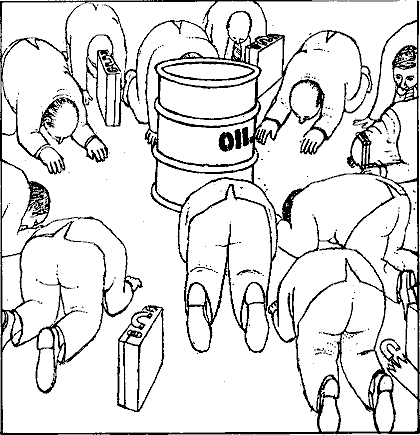
What if all of a sudden Jamaica were to strike it rich, like we discovered a source oil, natural gas, gold or diamonds?

Evidence suggests that that could be one of the worse things we could wish upon ourselves.

Trinidad is currently undergoing an oil and natural gas boom that is fast becoming a source of concern to some of its citizens.

Why so?

Recent past history tells us that developing countries that "discover" a single source of a new mineral commodity end up wrecking their economies. Oil and natural gas are the most recent instigators, but gold, diamonds and other precious ores have also played their part.

How does this happen?

Well, believe it or not, it could be compared to hitting the lottery, which often involves
  • changing locks, phone numbers, addresses, names, etc. to gain some relief from the public
  • being informed of "new" cousins that claim kinship, and a cut of the winnings
  • family members and friends who refuse to talk to you after you refuse them their "share"
  • complicated new choices on taxes and investments
  • hiring a lawyer and accountant (at least)
  • new "friendships" based on what you have, rather than who you are
  • saying "No way" more often than "Yes" to worthy causes and needy people
  • being included by thieves and other dirty, rotten scoundrels in their short to medium term career planning
I have never won anything in my life, but I once met someone whose lottery-winning uncle refused to fund her continuing education once she decided to switch from Pre-Med... causing her to drop out in mid-semester.

The problem with a windfall is that it distorts things. Undeserved and unearned resources are placed in our hands. We have an instant material power that is unmatched with equal wisdom. Our capacity to live life productively remains unchanged, but Lady Luck has granted us the fruits of a windfall and fate demands that we deal with them nonetheless.

The new NBC series "Windfall" offers an interesting and dramatic account of one group of lottery winners.

Trinidad's current windfall is actually its second, and the last one was bad enough and recent enough to have those with long memories nervous. Some of the effects of $75+ per barrel oil are already plain to see.

  • Rising GDP and government revenue have served to stimulate an appetite for instant wealth, leading to a startling increase in kidnappings. The disparity in income between the lucky and the unlucky expands dramatically and quickly.
  • Government's desire to increase employment led to the creation of artificial employment in the form of the CEPEP program and others. In short, they provide a decent wage for a disproportionate (in other words, small) amount of value. The end result is an indecent one, however - first wage inflation, and now a labour shortage.
  • Increasing traffic, but few new roads being built. Several spots have become nightmares, such as the roads into Maraval and Diego Martin.
  • Port of Spain's real estate prices have risen dramatically fuelled by the demand by expats related to the oil industry
  • While the oil and natural gas sectors are booming, the non-oil related economy is stagnant. In short this means that the only thing separating Trinidad from other developing countries is the price of oil on the world market - a commodity price over which the country has no influence
Could we expect the same things in Jamaica if we were to make the same kind of discovery?

  • Would our crime increase in the same way, as people's expectations collectively rise more quickly than incomes?
  • Would our real estate prices also explode?
  • Would government policies also encourage under-employment, and a labour shortage?
  • Would the economy come to rely on unsustainable factors such as the price of oil on the world market?
Countries such as Nigeria and Venezuela have clearly suffered historically from their windfalls, leading some to say that the discovery of oil is the worst blessing that a country could pray for.

The remedy seems to lie in a commitment by government to the long term development of its people, increasing education and its sister, productive capacity, faster than expectations of instant wealth.

Would our politicians resist the temptation to forego easy spending to gain votes? Finance Minister's Omar Davis' recent admission that he authorized election spending to gain votes legitimized common, if unspoken knowledge. His words gave us no confidence that he and others would act any differently.

Labels: ,


Read more!

7/10/2006

Shortage of Labour

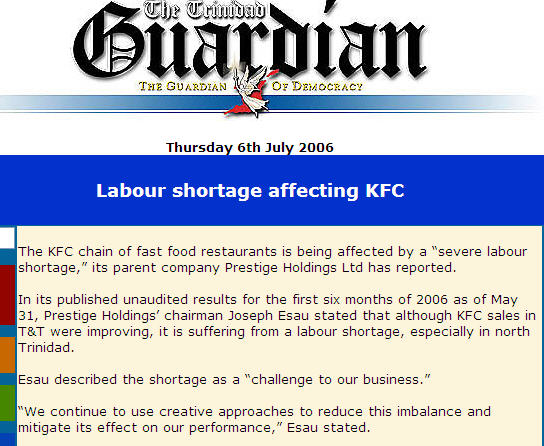
The Trinidad Guardian is reporting a phenomena that I mentioned earlier this year that to us here in Jamaica is astounding: Trinidad is nearing full employment.

The evidence being presented is that outlets like KFC are having a hard time finding sufficient labour to staff their restaurants, and at least one owner of another fast-food outlet echoed the same sentiment to me recently.

This will be a real test for CSME, which is specifically intended to correct imbalances like these.

Guyana and Jamaica have tremendous unemployment problems, yet Trinidad only competing with Barbados in the minds of people across the region, for the title of the most difficult place to which one can legally migrate. Just the other day, an acquaintance of mine had to return to Jamaica after encountering work permit difficulties after several months of living in Trinidad.

Unfortunately, the CSME legislation was only very recently expanded to include nurses and teachers. It looks like it will be some time before casual workers are included, if ever. So fast-food outlets in Trinidad will continue to have the problems they are having, and it is likely to only get much worse before it gets any better.

Labels:


Read more!

7/07/2006

Digicel in Haiti

Hot on the heels on the article on Digicel in Trinidad, comes a blog entry on the entry of Digicel into Haiti -- very interesting reading.

Labels:


Read more!

Digicel vs. TSTT

In an earlier post, I described how Digicel was culturally missing the boat in Trinidad and Tobago.

In the excellent online magazine -- Caribbean360.com -- Ian Alleyne gives some interesting insights into what has transpired over the last year or so, giving the impression that Digicel has blown the opportunity to capitalize on the deep resentment Trinis have had with TSTT, which I consider to be even worse than C&W ever was here in Jamaica.

Click here to go to the full story


Incidentally, I spent 112 minutes on hold calling C&W yesterday's billing toll-free line, before giving up...

Labels:


Read more!

4/04/2006

An Excerpt from Tantie

"Tantie" is a Trini word meaning Auntie, that in Jamaica means "Teh-Teh" or "older female relative, usually an aunt, who can really talk".

This excerpt is from a weekly online newsletter called Tantie which is sent out in Trinidad. One section, "Backchat", is an opportunity to folks to send back their impressions, and this Trini's response caught my attention.

* T R I N I D I A R Y http://www.trinidiary.com *
* your source for events in Trinidad and Tobago *
* ~~~~~~~~~~~~~ *
* *
TUESDAY 4th APRIL 2006 VOL:7 ISSUE:014

BACKCHAT: Issue 013

So wearing black as a sign of mourning I can live with.

But driving with car lights on to protest crime??? Walking against crime? Signing a petition to be delivered to our "figurehead" president? WHAT exactly do, or will, these actions EVER accomplish? To whom are we protesting? Neither the criminals nor the politicians care!

Volunteer your time and expertise to a civil society organisation working to alleviate our myriad social problems....and THEN talk to me about crime solving.

Donate a part of your paycheck to one of these same organisations, or to a family that can barely pay its rent and eat when the month comes, and THEN talk to me about crime solving.

STOP driving on shoulders, putting on your seatbelt only when you see a police officer, and breaking rules whenever you have the chance....and THEN talk to me about crime solving.

Sensitise your children to be compassionate for their fellow humans, to love everyone as they come, and to be generous with the gifts that the universe so bountifully bestows....AND THEN TALK TO ME ABOUT CRIME SOLVING!!!

Leave your comfort zones behind. Judge not, lest you be judged. Love thy neighbour as thyself. Increase the talents given to you by the universe, and use them for the good of your downtrodden fellow people. //Trinidad

Labels: ,


Read more!

4/02/2006

Beating Our Backs to Stop the New Plague

A few days ago I was reading the Trinidad Guardian online, and noticed that, in response to the recent rise in murders in 2006 (+37%) someone had called for a day for everyone to protest by wearing black, and putting headlights on for the entire day.

This follows a recent day of mourning where everyone wore white, and performed a symbolic act that involved lying in the streets of Port of Spain.

And there have been countless calls for prayers, fasting, a greater role for church leaders, condemnation for criminals, protests, etc.

I can tell the Trinis from experience: these things don't work.

We in Jamaica have an abundance of evidence that they make no measurable difference. Our murder rate almost tripled in the past few years, and we are doing as many of these kinds of things as we can think of, including mass rallies of all kinds. I happen to live beside a church that insists on sharing the Sunday services with the neighbourhood through its loudspeakers that face out from the church. Every week, (and on many weekdays) there are loud calls for God's redemption from the crime that has turned us into the Murder Capital of the world.

I cannot see that these tactics are working, and I doubt that they will work any differently in Trinidad.

On the History channel this afternoon, I happened to see a programme on the Black or Bubonic Plague in Europe, that wiped out half the population of the continent. Like us, people in the 1300's sought to find religious solutions to the horror of the illness, which killed people within days after causing high fevers, chills, vomited blood and black boils. They sought refuge in the Catholic Church, and from the Pope, who of course was powerless to stop the carnage. There was one very moving picture depicted of a statue of the Virgin Mother being taken miles from one place to the other to help ward off the evil -- to no avail.

At some point, a few
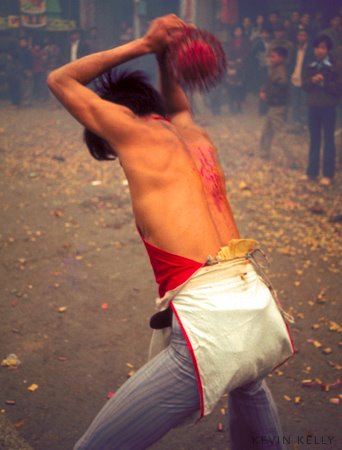
in Germany decided that the priests were not being godly enough, and started a group they called the Flagellants. Membership in this group was restricted to those who were willing to spend days marching through the streets beating themselves (and each other for good measure) until their backs were rendered a bloody mess.

They eventually took to beating first Jews and then priests, at which point the Pope decided he'd had enough and brought out the troops to stop their fun.

From our point of view it is a curious sight -- men beating themselves on the back with whips in order to... stop the Bubonic Plague. Given that the Plague was spread by a bacterium from person to person through bodily contact, it must seem to us to be a pretty bad choice of cures.

Which brings me to Trinidad. I think we Jamaicans can teach them a thing or two about some of the things that we have tried that just do not make any difference. In fact, it strikes me that reinforcing some religious beliefs can not only deepen crime and violence, but also further divide our societies.

How so?

There are lots of Bible verses, for example, that people use to sanction violent acts like beating children, discriminating against gays and promoting the death penalty. Recently, a group of Christian lawyers in Jamaica appeared to be protesting against the new Charter of Rights because it did not discriminate against gays sufficiently.

The book "The Sins of Scripture" by an Episcopalian bishop is a eye-opening excursion into church history that outlines many of these ways in which the claimed "inerrancy" of the Bible is used to justify all sorts of historical and present-day evil, in the name of God.

Furthermore, using religion is the quickest way to divide our people within the countries that make up the region.

For example, our new Prime Minister made a call yesterday at a Seventh Day Adventist church that pastors will be appointed to boards of government institutions across the country. In principle, having a spiritual viewpoint in positions of power is an excellent idea.

However, the truth is that we all have our favourite religions, including our new Prime Minister, and we would want our favourite pastors to be appointed to the more important positions.

Furthermore, we also have those religions that we either fear or despise. The great thing about the "Church of Satan" in the USA is that its very existence stops the government from going too far in the direction of mixing church and state.

While I doubt that there is a chapter in Jamaica, there are enough denominations and religions that exist that most of us don't want to place anywhere near the levers of power. These include the old chestnuts such as Jehovah's Witnesses, the Mormons, Catholics, Rastafarians and the permanently crusading clap-hand tent church around the corner. To hear that the pastor who recently prophesied that Portia would win the race to become the next Prime Minister has been appointed to the board of the Electoral Office of Jamaica would probably worry everyone who does not belong to his church.

Perhaps Portia will come up with a short list of approved churches and pastors, to prevent the boards from making errors. Then, we could all know which religious leaders have received the stamp of approval.

But, that would probably put us all in even more trouble. I could imagine that fracas that would break out, as power is given to some and not others, and placed in the hands of some holy men and women, but not others.

Having said that, I do have a few ideas to share with the readers of this website from a prior blog: "The Source of Crime in Jamaica".

More on this to come in future posts.

Labels: ,


Read more!

3/30/2006

Starting a New Conversation

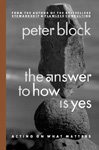
In reading and listening to Peter Block's brilliant book -- "The Answer to How is Yes" -- I was struck by a rather obvious statement.

He spoke about the need for change to start in companies through the creation of a new conversation.

A new conversation.

That means going past stuff that has already been said, opinions that have already been shared, histories that have already been explored, facts that are already known, responsibility that has already been taken, roles that have already been defined, steps that have already been taken.

While the content of these existing conversations may be correct, they are not new.

A new conversation results in new actions that come from new degrees of personal responsibility.

This is why increases in praying and fasting and supplication have done nothing to reduce the crime rate across the region (which has been increasing).

At least, not through the prayers we have been praying!

Maybe a new prayer would be "Lord, show me where I am contributing to the crime." That would certainly be the start of a new conversation between the Lord and the supplicant.

What kinds of conversations can we Jamaicans create around us to generate new dimensions of personal responsibility? He has mentioned a few in his book that I am eager to share in this forum, in some shape or form. His ideas are quite challenging, and quite applicable to us here in the Caribbean.

For example, he raises the notion that change starts with new conversations for personal responsibility, rather than ending with blame being assigned.

So... I ask myself... where have I contributed to the crime we have?

P.S. A recent study showed that prayer had no effect on heart patients, and in fact resulted in complications for some heart patients who knew they were being prayed for: Click here

Labels: , ,


Read more!

11/28/2005

CSME -- Offense or Defense?


In a recent conference on the impact of the CARICOM Single Market and Economy (CSME) there was a presentation by a representative of CSME. During her presentation it struck me that the reasons being given for the implementation of CSME were defensive rather than offensive.

In other words, the CSME was being formed to protect the region from the adverse effects of being very small countries. It seems that in key negotiations, our territories have suffered from not having sufficient clout in important international negotiations.

In short, CSME will enable us build a trading bloc that will enable our governments to accomplish more.

There is nothing wrong with this rationale, except that it's all about reacting to circumstances, and attempting to right a weakness.

As a business-person, however, I think that while that objective is a worthwhile one, it doesn't do a whole lot in the short term for my business.

And this is the challenge -- CSME is not being sold with enough of a vision to attract the average man.

I am sure there are people who are creating such a vision, but they are yet to be heard from.

I wonder if this has something to with Federation, and whether it was not fulfilled due to Jamaica's 1962 withdrawal? Are people feeling that if they create too big a vision for the region, then the old suspicions will be rekindled, and a collapse would ensue?

Or is it that there is a subtle fear that if CSME is too successful, then our countries will be overrun by foreigners from the countries that we are not so fond of?

There needs to be a much more clear vision for the new world that CSME is creating, and I'm going to get the ball rolling by painting the picture for myself.

Labels:


Read more!